
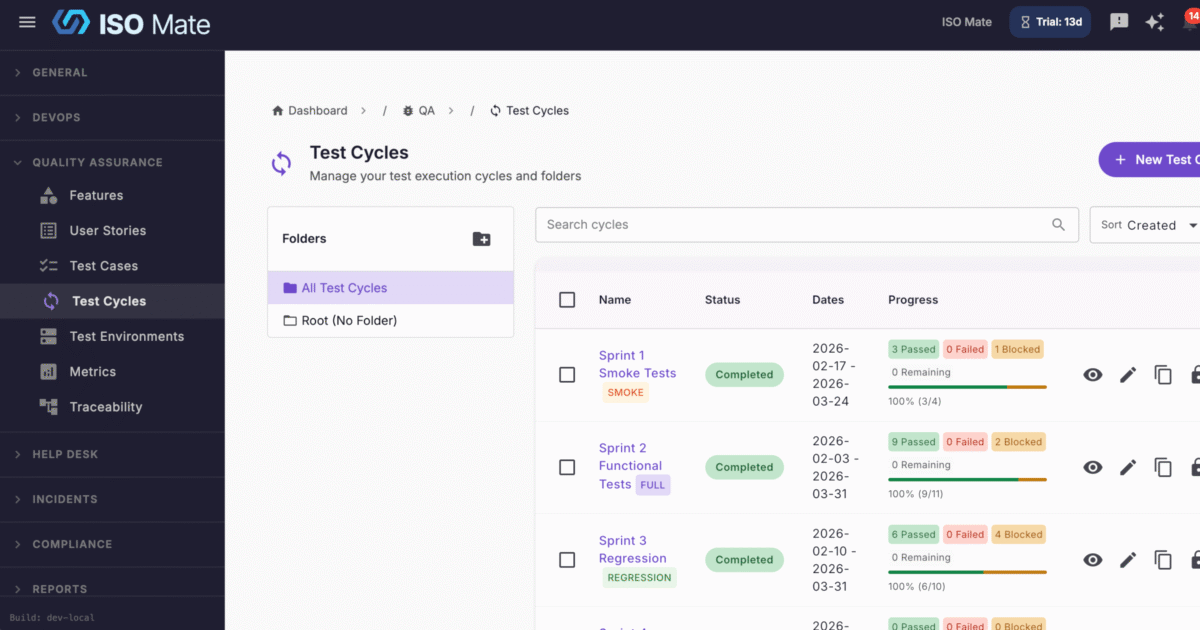
Know exactly what has been tested and what still needs coverage. QA Management gives quality teams one place to plan tests, run them, and prove coverage from requirements all the way to results.
The challenge it solves
Testing knowledge often lives in scattered spreadsheets and personal checklists, so it is hard to know which requirements are covered, which tests failed, and whether a feature is safe to ship. Coverage gaps slip through, results get lost, and audits turn into a scramble. QA Management brings requirements, test cases, executions, and coverage into one connected workspace.
What you can do
- Turn requirements into coverage: organize Features and User Stories with priorities, then link acceptance criteria directly to the test cases that verify them.
- Build a reusable test library: write test cases with ordered steps, expected results, preconditions, and estimated duration, then clone them to create variations fast.
- Test with the right data: version test cases, set dependencies for execution order, and drive data-driven runs with parameters and parameter sets.
- Organize every testing effort: group test cases into cycles for regression, smoke, or release validation, track progress, and close cycles when done.
- Record results step by step: mark each step Pass, Fail, or Blocked, attach screenshots and evidence, log defects from failed tests, and note the environment each run used.
- See coverage and gaps clearly: follow a multi-level traceability matrix from Features to User Stories to Acceptance Criteria to Test Cases, backed by a QA metrics dashboard for testing health.
Popular use cases
- Regression testing: build a cycle of existing test cases and run it before every release to catch breakages.
- Release validation: confirm every acceptance criterion is covered and passing before you sign off on a version.
- Requirement traceability for audits: show reviewers which tests verify each requirement, with an exportable matrix.
- Defect triage during QA: log failures as defects straight from a failed step and hand them to the development team.
- Acceptance testing for clients: run repeatable acceptance checks for client deliverables and internal sign-off.
- Data-driven testing: run the same test across many input sets using parameters and parameter sets.
Works with the rest of ISO Mate
QA Management is tightly connected to delivery. Link test cases to issues in DevOps Management so every defect and feature carries its test coverage and traces end to end. Trigger Workflow Automation on test cases, cycles, and executions to open an issue automatically when a test fails or to start follow-up tasks. Track quality with dedicated QA reports in Reporting and Analytics, create test records by describing them to the AI Assistant, and stay informed with QA notifications.
Key benefits at a glance
- Full lifecycle in one place: requirements, test cases, cycles, and executions stay connected.
- No coverage blind spots: the traceability matrix shows exactly what is tested and what is not.
- Faster, cleaner testing: reusable, versioned test cases and cloning cut repetitive setup.
- Audit-ready evidence: exportable results and matrices document quality on demand.